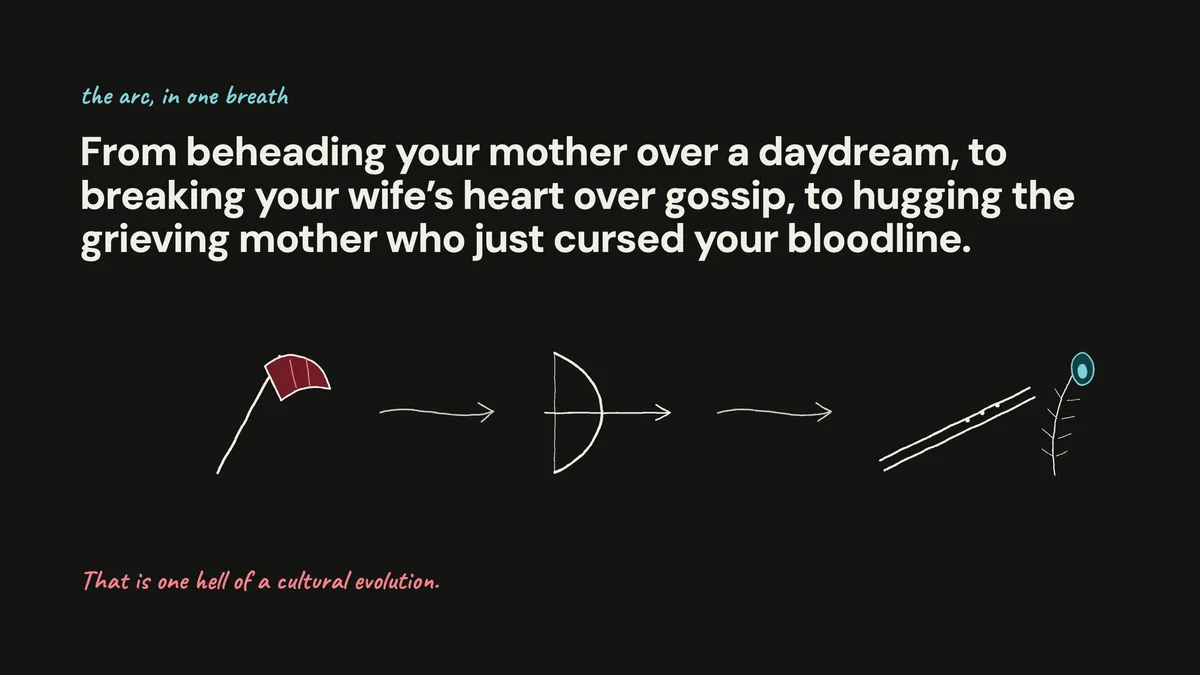
Vishnu Unlearns Toxic Patriarchy
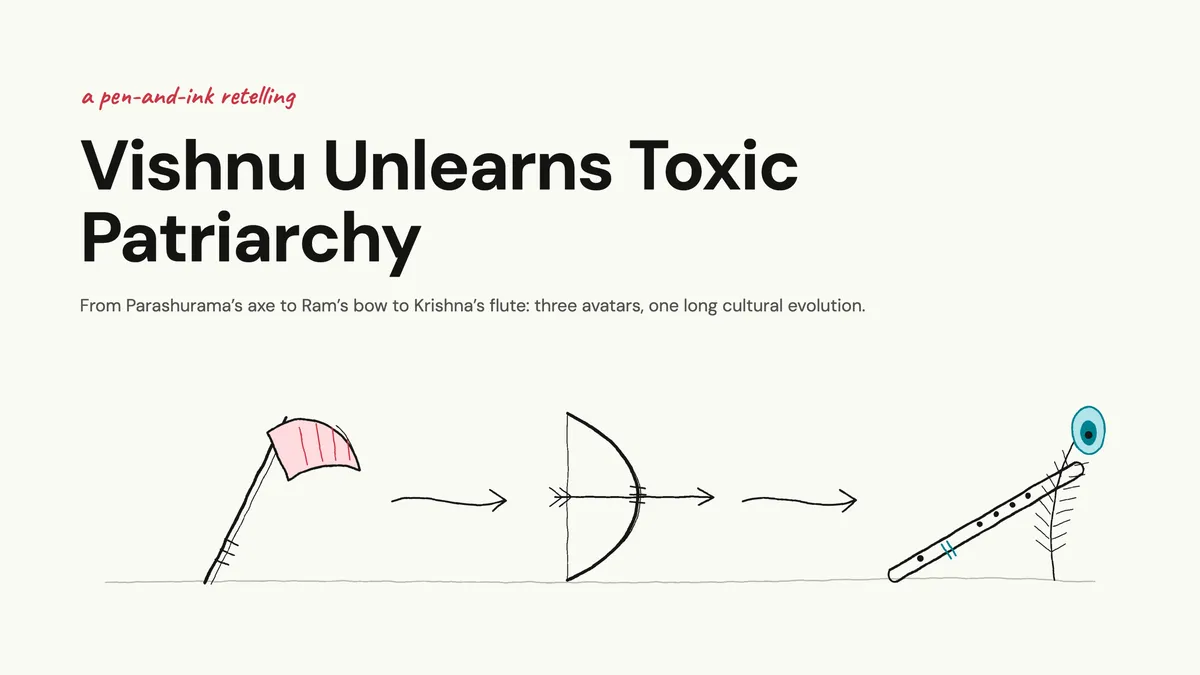
Remember when the movie Animal came out a couple of years ago, and half the country lost its mind debating whether Ranbir Kapoor’s unhinged, gun-toting "Papa, Papa" obsession was peak toxic masculinity?
Honestly, amateur hour. If you want to see toxic father-worship dialled up to psychotic levels, meet Parashurama, the axe-wielding sage who lurks in the background of both epics - Ramayana and Mahabharata.
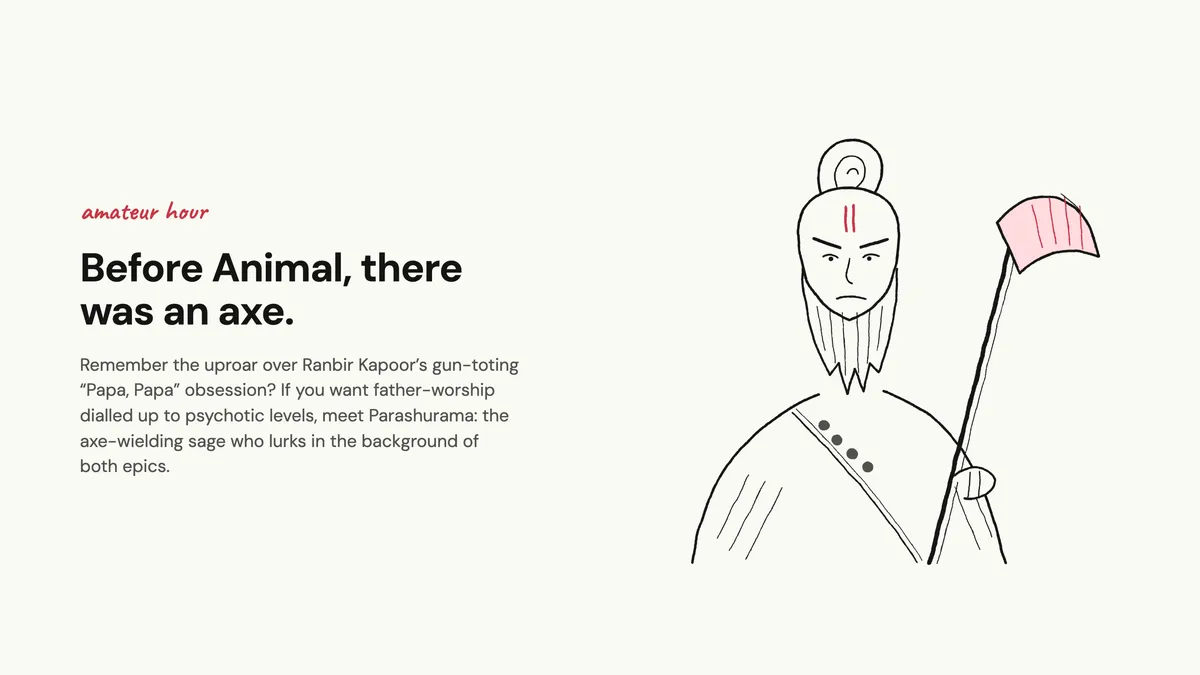
Parashurama’s mother, Renuka, was a sati, so fiercely chaste that her spiritual heat let her mold unbaked river clay into pots and carry water home. One afternoon by the river, she spots a handsome king playing in the water. For a split second, a stray thought of desire crosses her mind. She doesn't touch him; she doesn't even speak to him. Just a thought. Instantly, her clay pot dissolves. When she gets home wet and empty-handed, her husband, the sage Jamadagni, figures out why and flies into a rage. He calls his sons one by one and orders them to chop off their mother’s head. The first four sons are horrified and refuse. Then comes daddy’s favourite boy, Parashurama. Without blinking, this dude picks up his axe and decapitates his own mother just to please his father.

(Apologists love pointing out that when Jamadagni offered him a boon for his obedience, Parashurama asked for his mother to be brought back to life with no memory of the murder. Great, cool trick, he still swung an axe through his own mother’s neck because his dad couldn't handle his wife having a three-second daydream.)
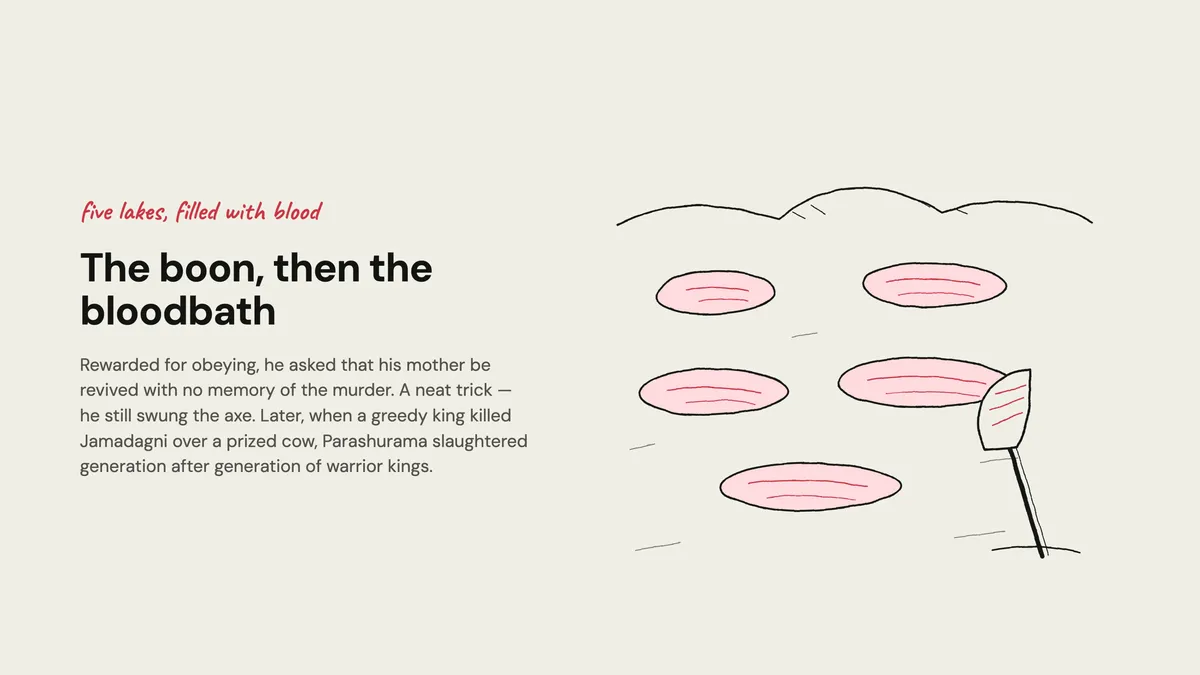
Later, when a greedy king kills Jamadagni over a prized cow, Parashurama goes on a genocidal rampage, slaughtering generation after generation of warrior kings and filling five lakes with their blood.
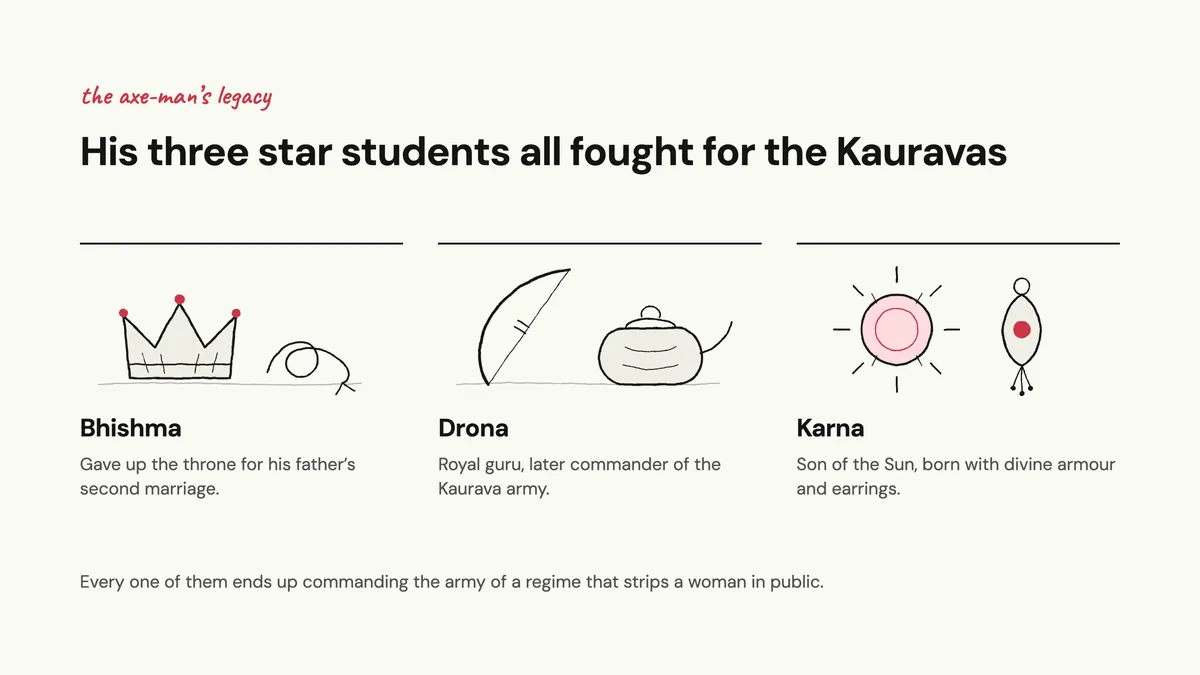
Look at his legacy in the Mahabharata: who are Parashurama’s three star students? Bhishma, Drona, and Karna. Every single one of them ends up commanding the Kaurava army, defending a regime that strips women in public!
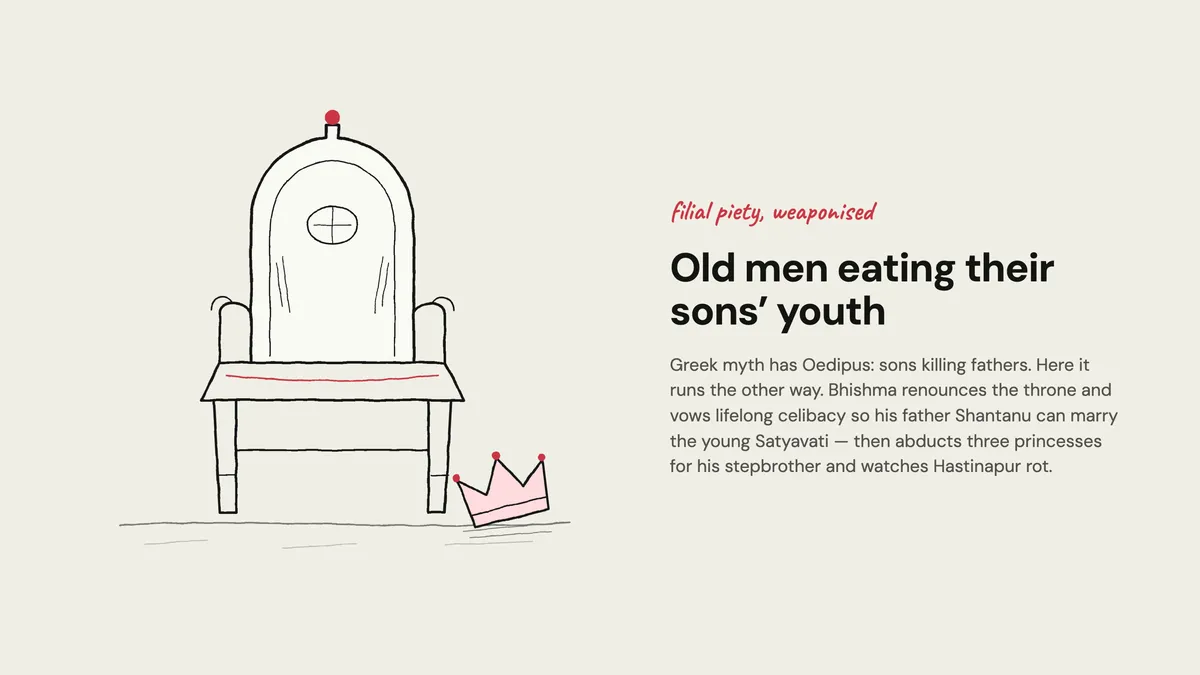
Bhishma himself is peak toxic filial piety. Whereas Greek myths have the Oedipus complex, sons killing fathers, Indian stories often suffer from the exact opposite: old men eating their sons' youth. Bhishma gives up his throne and vows lifelong celibacy just so his horny old father Shantanu can marry a young fisherwoman, Satyavati. Because Bhishma cares more about pleasing his dead dad’s memory than running a healthy kingdom, he abducts three princesses at sword-point for his weakling stepbrother and spends decades watching Hastinapur rot from the inside.
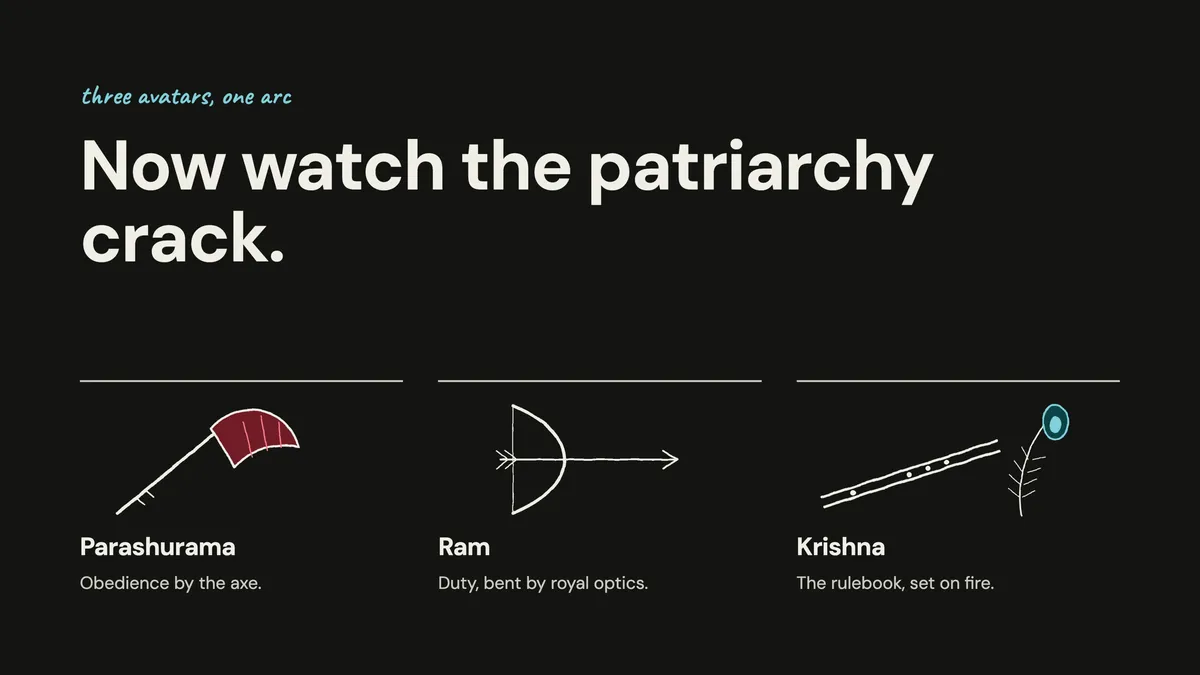
Now watch how that suffocating patriarchy slowly cracks open as you move from Parashurama, to Ram, to Krishna.
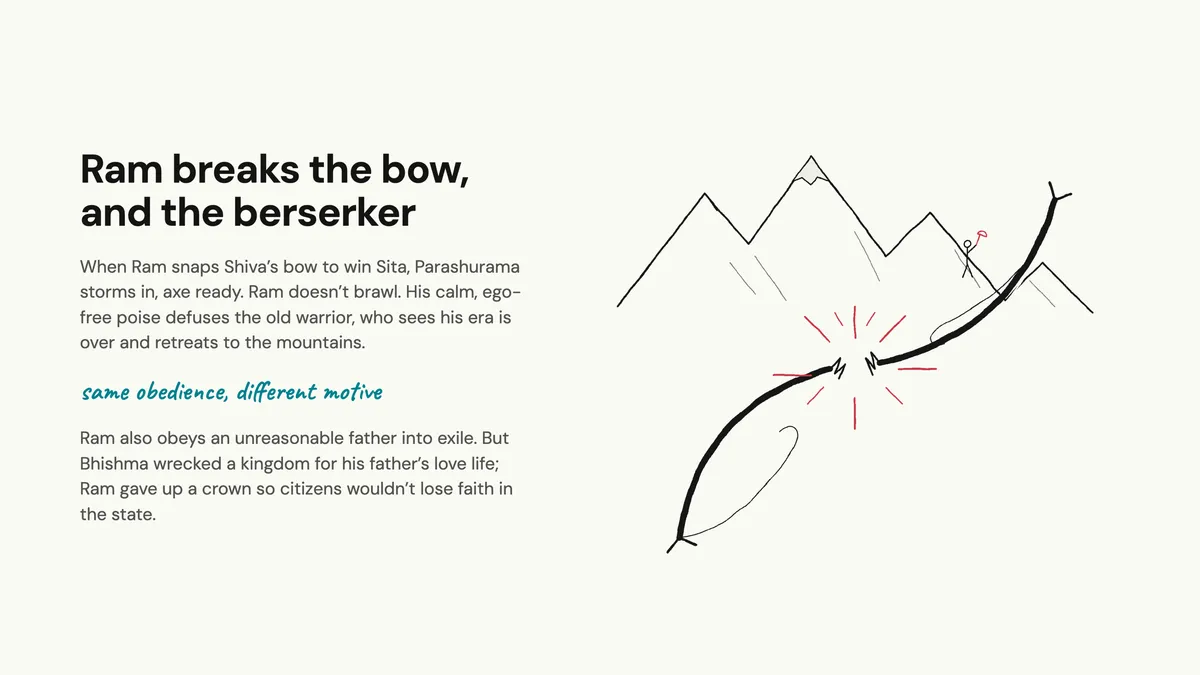
When Ram breaks Shiva’s bow to win Sita’s hand, an angry Parashurama storms in, axe on his shoulder, ready to put another arrogant prince in the ground. Ram doesn't brawl with him; his calm, ego-free poise completely defuses the old berserker, who realizes his era is over and retreats to the mountains.
Like Parashurama and Bhishma, Ram also obeys an unreasonable father when Dasharatha exiles him for fourteen years to appease his younger wife Kaikeyi. Modern readers often lump Ram and Bhishma together as "obedient sons," which misses the motive entirely. Bhishma ruined a country’s future to indulge his father’s sex life. Ram gave up his crown so citizens wouldn't lose faith in the integrity of the state.
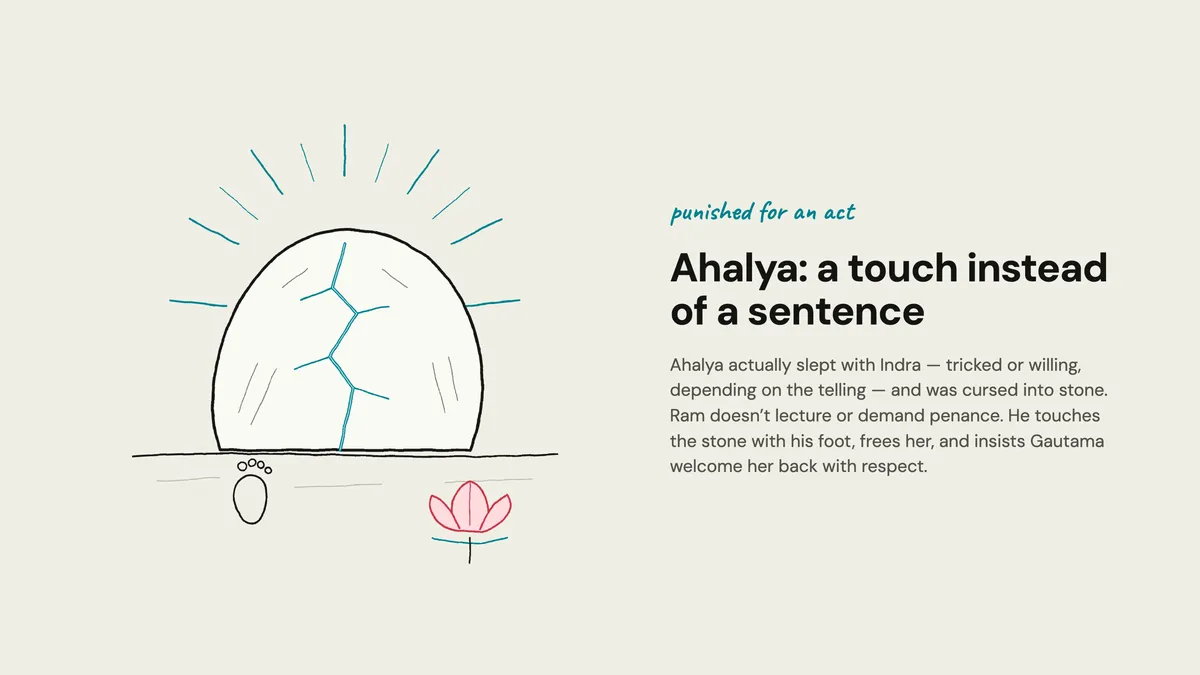
And look at how Ram treats women’s "purity" compared to Parashurama’s household. Renuka got her head chopped off for a thought. In the Ramayana, Ram walks into the desolate hermitage of Gautama, whose wife Ahalya actually slept with Indra (whether tricked or willing, depending on the telling) and was cursed to turn to stone. Ram doesn't lecture her, shame her, or demand penance. He touches the stone with his foot, frees her, and insists her husband welcome her back with respect.
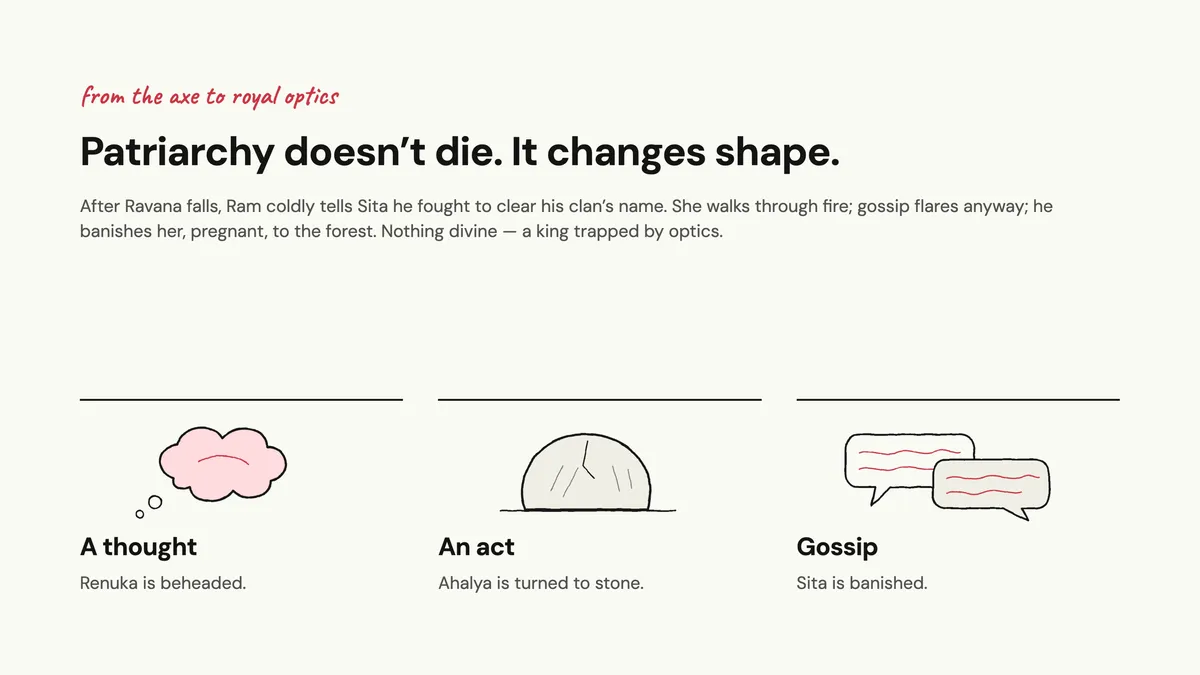
Of course, patriarchy is far from dead in Ram’s world; it has just shifted from domestic axe-murder to the crushing, paranoid policing of "family honour." We shouldn't sugarcoat how Ram treats Sita after killing Ravana. First, he meets her in public and coldly tells her he fought the war to clear his clan's name, not for her, and she’s free to go wherever she wants because a king can't take back a woman who lived in another man’s house. After she walks through fire to prove her chastity and returns to Ayodhya, street gossip flares up anyway, and Ram banishes his pregnant wife to the forest.
There is nothing divine about that moment. That is a man, a king, trapped by royal optics, prioritizing the Raghu clan’s spotless reputation over his innocent wife. Renuka was punished for a thought; Ahalya for an act; Sita is punished purely for gossip.
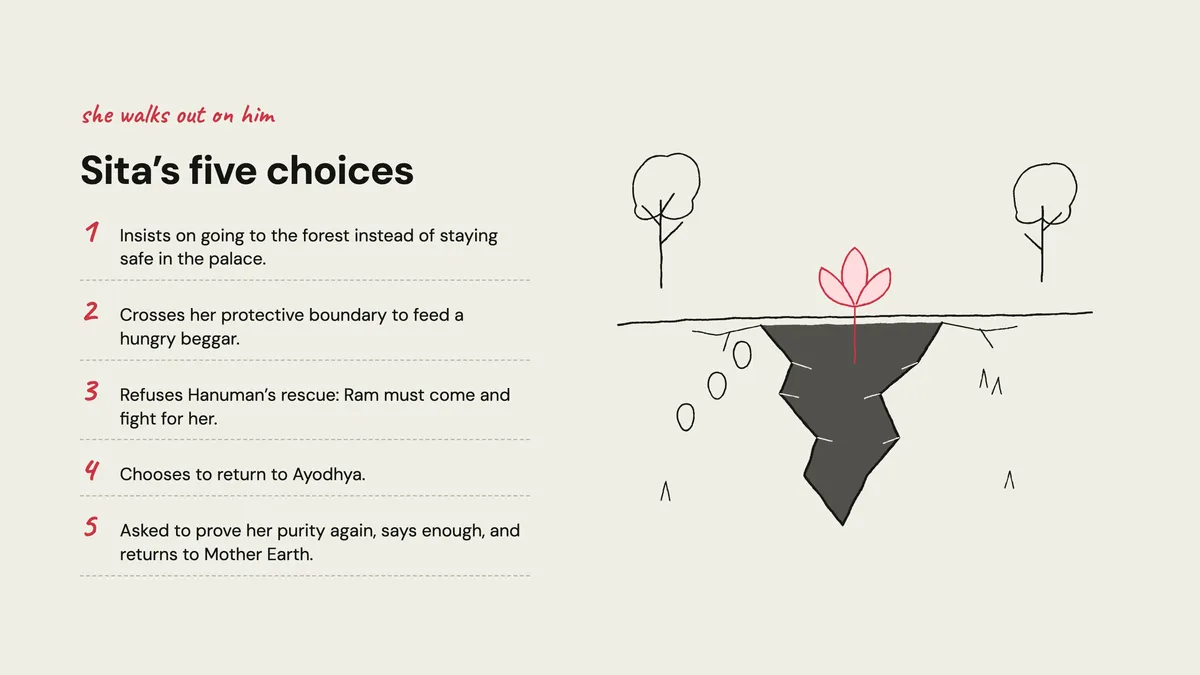
Yet even while showing us this tragedy, the epic quietly hands the moral victory to Sita. She is nobody’s passive victim. Think about it: Sita makes five massive choices on her own. She insists on going to the forest when told to stay safe in the palace. She crosses her protective boundary to feed a hungry beggar. She refuses Hanuman’s offer to carry her out of Lanka on his shoulders, insisting Ram come fight for her himself. She chooses to return to Ayodhya. And finally, after raising her twin boys alone as a single mother in Valmiki’s ashram, boys who beat Ayodhya’s invincible army and capture Ram’s royal horse, she looks at Ram when he asks her to prove her purity one more time in court, says enough, and descends back into Mother Earth. She walks out on him.
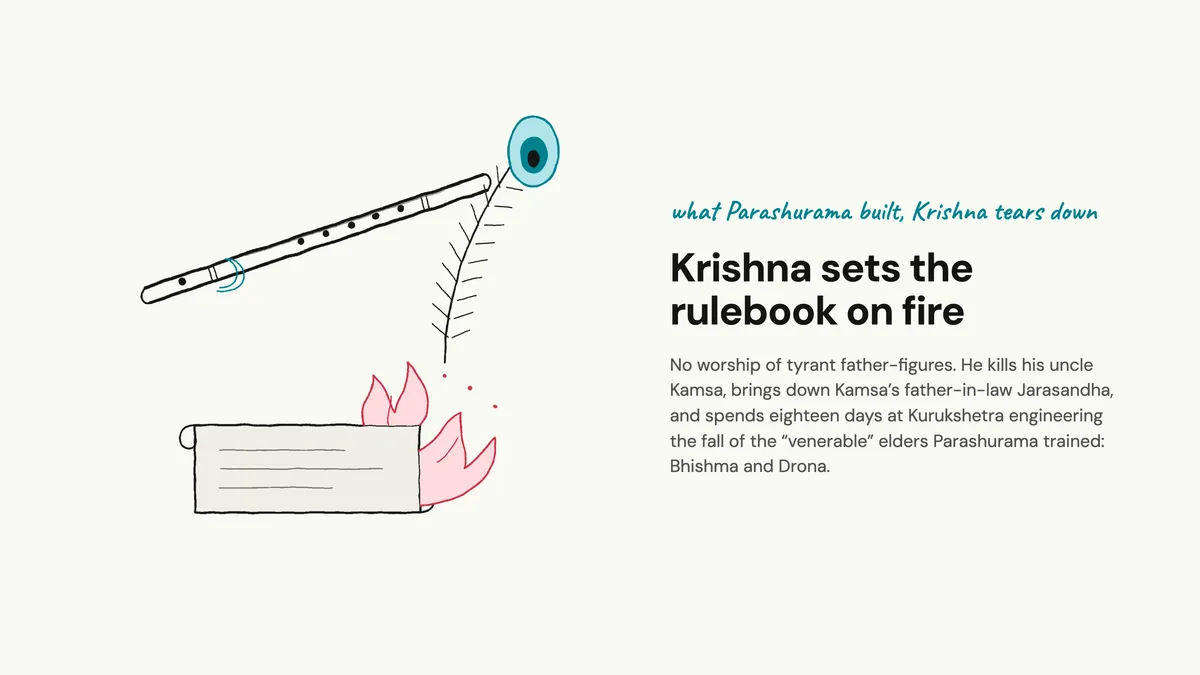
By the time we reach Krishna, the old patriarchal rulebook is set on fire.
Krishna doesn't worship toxic father-figures; he kills his tyrannical uncle Kamsa, takes down Kamsa's father-in-law Jarasandha, and spends eighteen days at Kurukshetra systematically engineering the deaths of the "venerable" elders, Bhishma and Drona, that Parashurama trained. What Parashurama built, Krishna tears down.
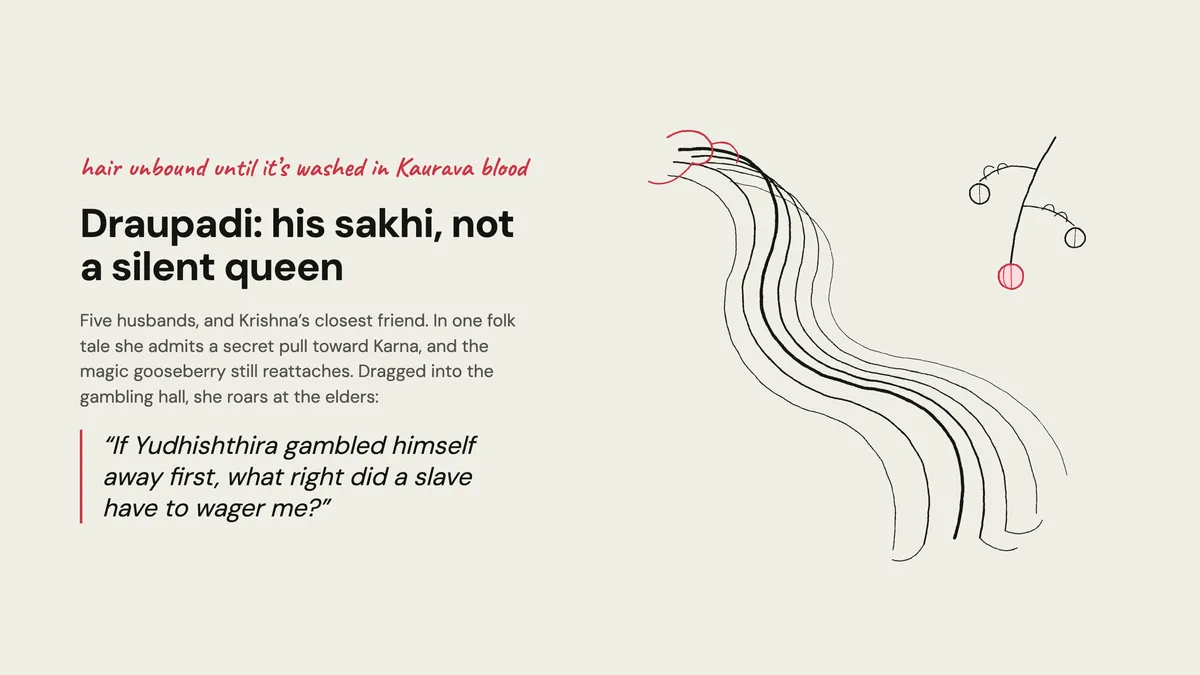
Look at Krishna’s relationship with women. His closest friend (sakhi) isn't a quiet, self-sacrificing queen; it’s Draupadi. Draupadi has five husbands. In a regional folk tale, when the Pandavas pluck a magical gooseberry in the forest and have to confess their deepest secrets to reattach it to the branch, Draupadi openly admits she harbors a secret attraction to Karna despite having five husbands, and the fruit reattaches, warning anyone with secrets of their own never to judge her! When she’s dragged into the gambling hall, she doesn't weep silently; she roars a legal question at the elders that leaves Bhishma tongue-tied: If Yudhishthira gambled himself away first, what right did a slave have to wager me? She leaves her hair unbound like wild Kali until she washes it in Kaurava blood, and Krishna backs her fury every step of the way.
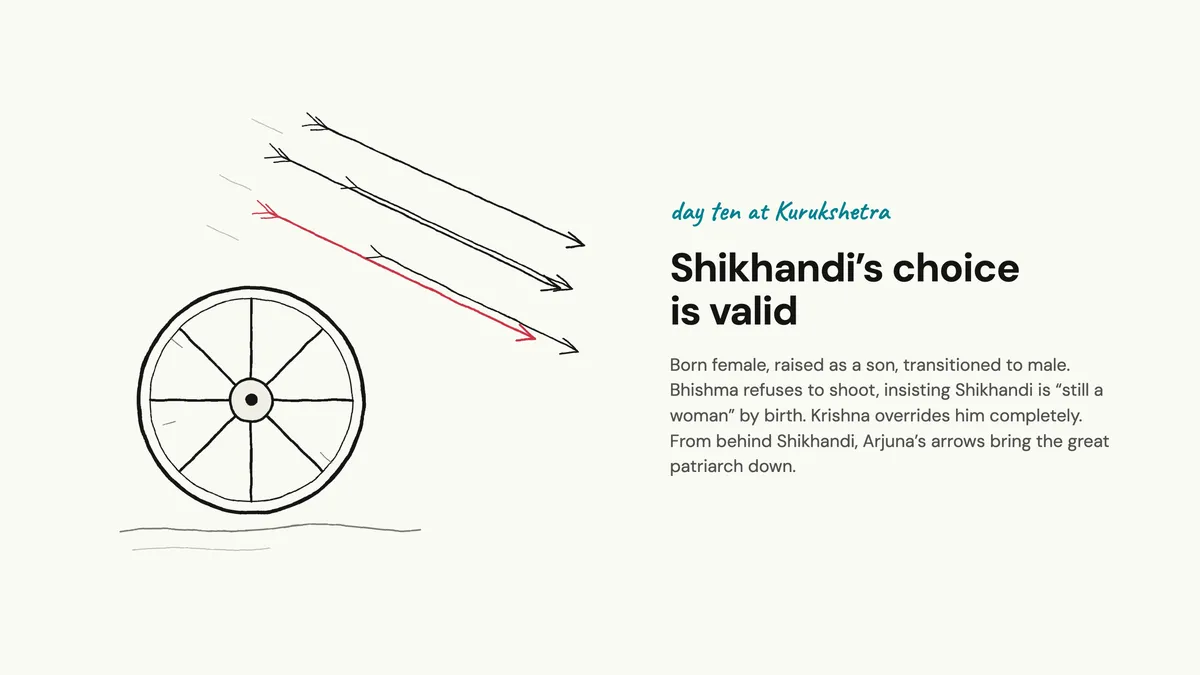
Even rigid ideas about biological gender get dismantled around Krishna. On the tenth day of the war, Bhishma refuses to shoot at Draupadi’s sibling, Shikhandi, who was born female, raised as a son, and transitioned to male, because the old patriarch stubbornly insists Shikhandi is "still a woman" by birth. Krishna overrides Bhishma completely: Shikhandi chose to be a man, and that choice is valid. Standing right behind Shikhandi, Arjuna riddles the great patriarch with arrows and brings the old order crashing down.
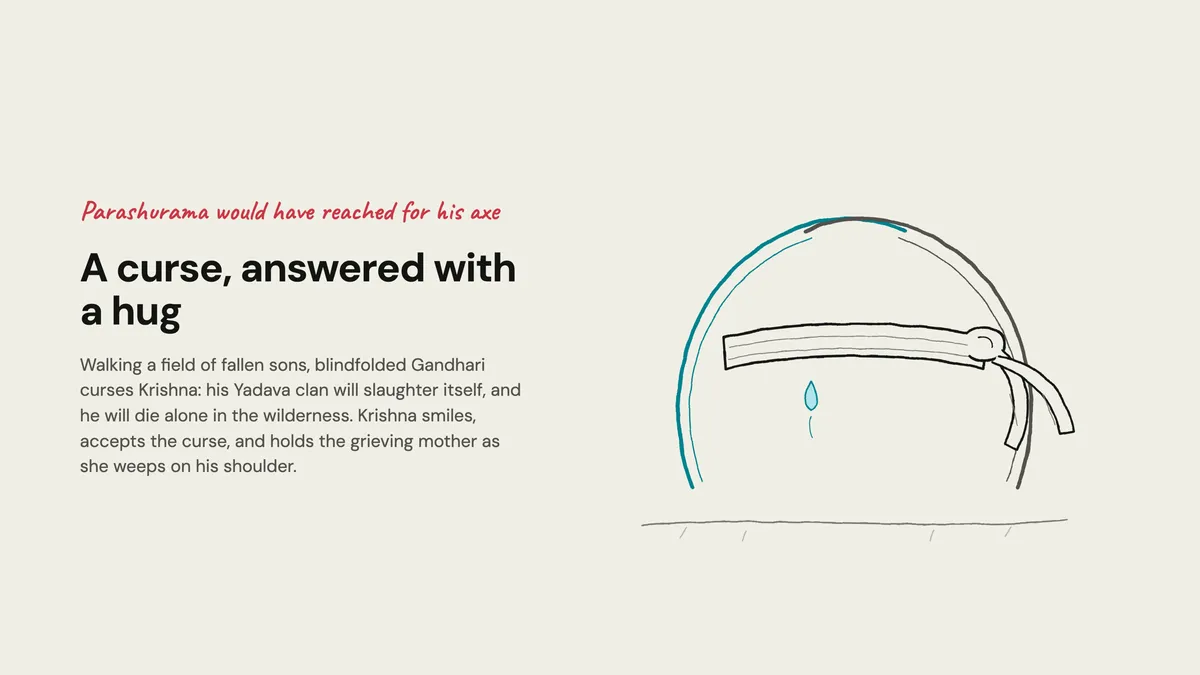
And at the end of the war, when blindfolded Gandhari walks across a field of rotting corpses, refuses to admit her hundred sons were villains, and furiously curses Krishna that his own Yadava clan will slaughter itself while he dies a dog’s death in the wilderness? Parashurama would have reached for his axe. Ram might have stoically accepted it from a distance. Krishna smiles, accepts her curse, and pulls the heartbroken old mother into a warm hug while she cries on his shoulder.
From beheading your mother over a daydream, to breaking your wife’s heart over street gossip, to championing an outspoken polyandrous woman and hugging a grieving mother who just cursed your bloodline, that is one hell of a cultural evolution.